
What is an interest-only mortgage? An interest-only mortgage is a type of home loan designed to provide borrowers with greater financial flexibility during the early years of borrowing. Under this arrangement, the borrower pays only the interest on the loan for a specified initial period, meaning the principal balance remains unchanged unless additional payments are made voluntarily. More from us: Grey Fence Paint for UK Gardens.
Because no principal is repaid during this phase, the monthly payments are significantly lower than those of traditional repayment mortgages, making this option appealing to individuals who want to manage short-term cash flow more effectively.
While interest-only mortgages can offer advantages such as increased short-term affordability and potential tax benefits in certain situations, they also carry notable risks, including payment shock, higher long-term interest costs, and limited equity buildup.
For this reason, understanding the full structure, benefits, and drawbacks of an interest-only mortgage is essential before deciding whether it aligns with your financial goals and long-term plans.
| Category | Details |
| What Is an Interest-Only Mortgage | Pay interest only initially |
| Initial Payments | Lower monthly cost |
| Principal Repayment | Starts after the IO period |
| Typical IO Term | 3–10 years |
| Loan Structure | Amortizing or balloon |
| Interest Rate Type | Fixed or adjustable |
| Equity Buildup | No automatic growth |
| Risk Level | Moderate to high |
| Best For | Investors, short-term owners |
| Main Advantage | Improved cash flow |
| Main Disadvantage | Payment shock |
| Refinancing Need | Often required |
| Tax Impact | Possible deductions |
| Suitability | Depends on the financial plan |
What is an interest-only mortgage?

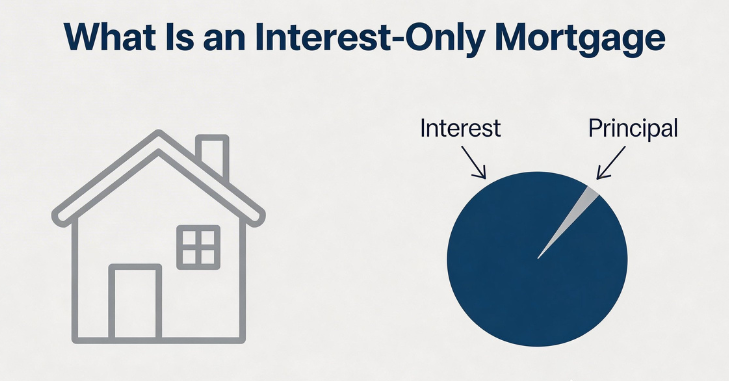
An interest-only mortgage is a home loan in which, for a specified initial period, the borrower pays only the interest charged on the outstanding principal. During this interest-only period, the monthly payments do not reduce the principal balance unless the borrower makes extra payments.
After the interest-only term ends, the loan typically… what is an interest-only mortgage? requires the borrower to begin paying both principal and interest, which increases the monthly payment, or the loan may require a balloon payment of the remaining principal.
How Do Interest‑Only Mortgages Work?
- You borrow a principal amount when the loan is originated.
- For a specified interest-only period (commonly 3, 5, 7, or 10 years), you pay only the interest charged on the outstanding principal.
- The principal balance remains unchanged during the interest-only period unless you voluntarily make principal payments.
- At the end of the interest-only period, the lender typically requires repayment of principal through amortization over the remaining loan term.
- Some loan designs instead require a lump-sum balloon payment at the end of the interest-only term.
Key Features
Length of the Interest‑Only Period
The interest‑only period can vary, commonly lasting three, five, seven, or ten years. This term determines how long the borrower avoids paying down principal and, therefore, how long the loan remains non-amortizing.
Interest Rate Type
Interest rates may be fixed for the interest‑only window or adjustable. Fixed rates offer predictable payments during the interest‑only term, while adjustable rates expose borrowers to payment variability when market rates change.
Conversion vs. Balloon
Some interest‑only loans convert automatically to full amortization at the end of the interest‑only term, recalculating payments to repay principal over the remaining loan life. Others include balloon clauses that require a large lump‑sum payment at a specified date unless the borrower refinances or sells the property.
Underwriting and Borrower Qualifications
Lenders typically impose stricter underwriting for interest‑only products. Common requirements include lower maximum loan‑to‑value (LTV) ratios, higher credit scores, and larger cash reserves to reduce lender exposure during the non‑amortizing period.
Types
Fixed‑Rate Interest‑Only Mortgages
Fixed-rate interest-only loans lock the interest rate during the initial interest-only period, providing predictable interest payments until conversion. Because the rate is fixed, borrowers know exactly what their interest‑only payments will be for that window, though the payment will increase when principal amortization begins.
Interest‑Only Adjustable‑Rate Mortgages (ARMs)
Interest‑only ARMs fix the rate for an initial period and then adjust periodically (commonly structured as 5/1 or 7/1), exposing borrowers to rate‑change risk. After the initial fixed interval, the interest rate and, therefore, the interest-only payment can vary with market indices, and later the loan converts to an amortizing loan based on the remaining term.
Balloon Interest‑Only Mortgages
Balloon interest-only loans require repayment of the outstanding principal in a lump sum at a predetermined date rather than converting to amortization. Borrowers using balloon structures typically plan to refinance or sell the property before the balloon payment is due; if refinancing is not possible, the borrower must pay the balloon or face default.
Construction‑to‑Permanent and Specialized Interest
Construction‑to‑permanent loans and certain commercial or investor‑targeted products commonly use interest‑only features during the building, lease‑up, or early‑ownership phases. These specialized forms accommodate staged income expectations, reduce initial carrying costs during development, and provide flexibility for short ownership horizons.
Risks and Disadvantages
- Payment shock: monthly obligations often rise sharply when the interest‑only period ends and principal repayment begins, which can strain borrowers who haven’t planned or saved for the increase.
- Rate volatility (for ARMs): adjustable-rate interest-only loans expose borrowers to changing market rates that can raise interest-only payments before conversion and amplify amortizing payments afterward.
- No automatic principal reduction: the principal remains unchanged during the interest‑only period unless the borrower makes voluntary payments, so equity builds only through property appreciation or intentional principal paydown.
- Vulnerability to price declines: Because equity depends on appreciation or extra payments, a drop in home values can quickly erode borrower equity and increase default risk.
- Refinancing risk: Many borrowers rely on refinancing or selling before conversion; credit tightening, higher rates, or falling property values can make refinancing difficult or impossible.
- Higher total interest cost: if principal is not reduced early, interest accrues on the full original balance for a longer period, often resulting in greater lifetime interest expense than a loan that amortizes from the start.
Tax and Financial Considerations

Although interest-only mortgages affect cash flow and may affect tax outcomes, their financial desirability varies depending on personal circumstances. Early years of an interest-only loan generate higher deductible interest than an amortizing loan in jurisdictions where mortgage interest on primary residences or investment properties is deductible.
For some borrowers, this can lower their after-tax borrowing costs. However, tax benefits should be verified with a qualified advisor due to changes in tax law and deduction limits. From a financial perspective, choosing an interest-only loan requires evaluating total interest costs, expected cash flow, refinancing options, and lower-risk alternatives.
Conclusion
An interest-only mortgage is a financing tool that provides short-term cash flow relief by suspending principal payments for an initial period. Still, it introduces distinct risks—most notably payment shock, rate exposure on ARMs, and the lack of automatic equity buildup.
They can be appropriate for disciplined borrowers with clear plans for handling conversion or for investors who understand the trade-offs. What is an interest-only mortgage? It should be evaluated in light of future income expectations, reserves, refinancing likelihood, tax implications, and alternatives. It can be a helpful part of a financing strategy when used carefully and with precautions; when used carelessly, it can cause significant financial hardship.
Want to know about Everything You Need to Know About First Response Finance: Services, Benefits, Application Process, and Expert Tips Check out our Finance category.
FAQs
With an interest-only mortgage, you can only pay interest on the money you borrow each month. No capital of the initial loan amount is repaid by these payments.
The inability to build home equity during the interest-only period, the possibility of interest rate fluctuations during the principal payment period, the risk of overspending during the interest-only period, and the volatility of the real estate market impacting property values are all drawbacks of interest-only mortgages.
Your lender will require you to pay off your interest-only mortgage in full with a single lump sum when it expires. I hope this won’t come as a surprise. A year before, six months before, and right before the expiration of your mortgage, your lender ought to have contacted you.
A repayment mortgage is typically the more economical choice for the majority of people purchasing a place to live. This is due to the fact that you will eventually own your house outright by paying off the loan and interest over time.