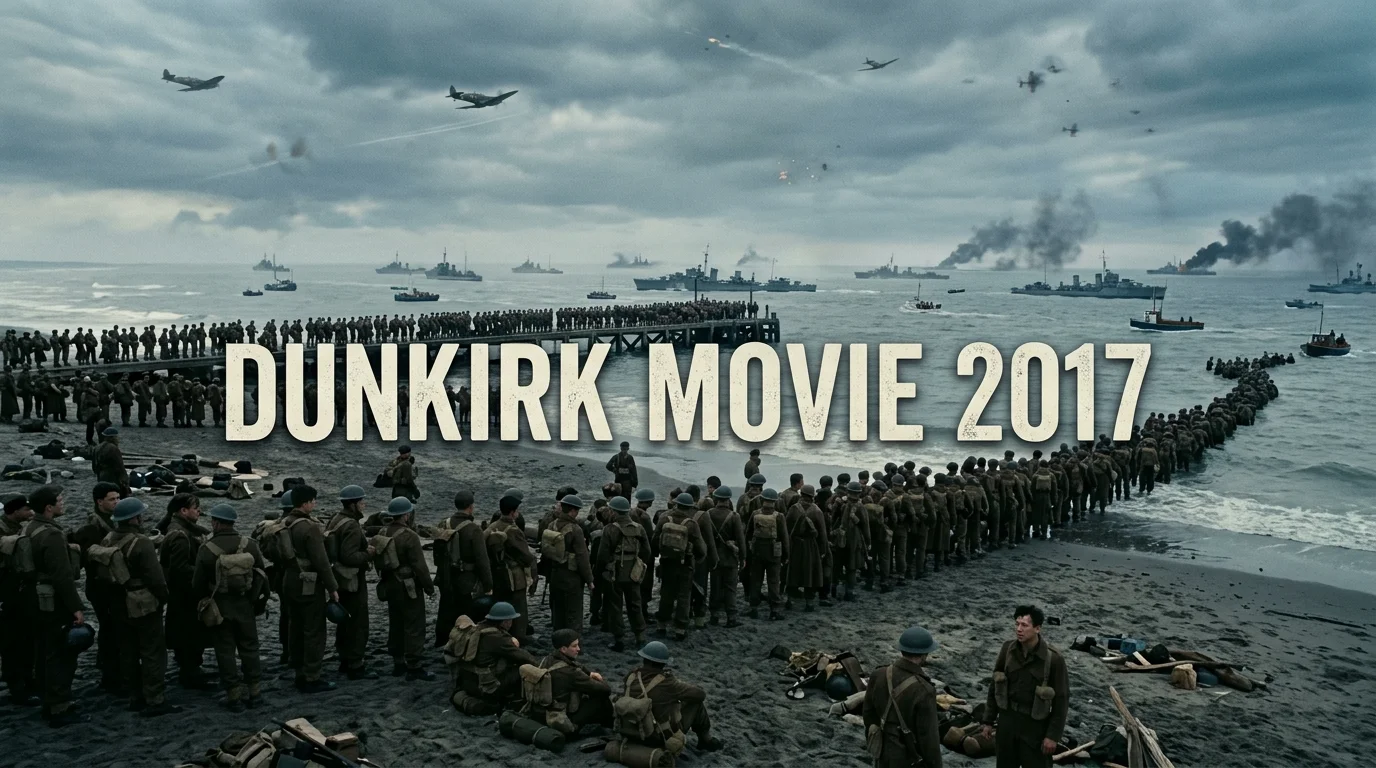
Christopher Nolan’s Dunkirk movie 2017 turns a famous Second World War evacuation into a tense survival story. Instead of following one traditional hero, the film moves between soldiers, civilians, and RAF pilots. Its unusual timeline, limited dialogue, practical action, and relentless sound create an experience built around fear and survival.
| Key detail | Information |
|---|---|
| Film | Dunkirk |
| UK release date | 21 July 2017 |
| Director and writer | Christopher Nolan |
| UK certificate | 12A |
| Running time | About 106 minutes |
| Genres | War, drama, thriller |
| Main cast | Fionn Whitehead, Tom Hardy, Mark Rylance, Kenneth Branagh, Cillian Murphy, Harry Styles |
| Music | Hans Zimmer |
| Cinematography | Hoyte van Hoytema |
| Setting | Dunkirk evacuation, 1940 |
| Academy Awards won | Film Editing, Sound Editing, Sound Mixing |
Direct answer: The film follows Allied troops trying to escape northern France during the 1940 evacuation. Nolan tells the story through three connected perspectives: land, sea, and air. Their timelines move at different speeds before meeting during the rescue. The result is a war film focused more on survival than conventional combat.
What Is the Dunkirk Movie 2017 About?
The story takes place during the Battle of France in 1940. Allied forces are pushed toward the coast and trapped around Dunkirk. Hundreds of thousands of troops need to be evacuated across the English Channel.
The film opens with young British soldier Tommy trying to reach the beach. He soon discovers that reaching the coast does not mean reaching safety. German aircraft attack from above, while evacuation ships remain vulnerable to bombs and torpedoes.
Elsewhere, civilian sailor Mr Dawson crosses the Channel in his small boat, Moonstone. His son Peter and young George accompany him on the dangerous journey. Their route eventually brings them into contact with exhausted soldiers and downed RAF pilots.
Above them, pilots including Farrier fight to protect the evacuation. Fuel becomes as serious a problem as enemy aircraft. These stories gradually converge as the rescue operation reaches its most dangerous stage.
Why Does Dunkirk Have Three Timelines?
Nolan divides the narrative into three strands called The Mole, The Sea, and The Air. Each strand covers a different amount of time. The beach story lasts one week, the sea journey one day, and the aerial story one hour.
The film edits these timelines together rather than showing them chronologically from start to finish. An event seen from one perspective can later appear again from another. This structure explains why certain scenes initially seem to happen out of order.
The approach also changes how the audience experiences time. A few minutes inside a fighter aircraft can feel as urgent as days spent waiting onshore. Once the three strands meet, earlier moments become clearer.
Dunkirk Cast and Main Characters
The ensemble cast mixes younger performers with established British and Irish actors. Fionn Whitehead plays Tommy, whose experience gives viewers a ground-level view of the evacuation. Harry Styles plays Alex, another British soldier desperate to get home.
Mark Rylance plays civilian boat owner Mr Dawson, while Tom Glynn-Carney portrays his son Peter. Barry Keoghan appears as George, who joins their Channel crossing. Cillian Murphy plays a traumatised soldier rescued at sea.
Tom Hardy portrays RAF pilot Farrier, while Jack Lowden plays fellow pilot Collins. Kenneth Branagh appears as Commander Bolton on the mole. Aneurin Barnard, James D’Arcy, and other performers complete the large ensemble.
The characters receive less backstory than viewers may expect from a traditional war drama. Nolan instead defines them through immediate decisions under pressure. That keeps attention on collective survival rather than one central protagonist.
How Historically Accurate Is the Film?
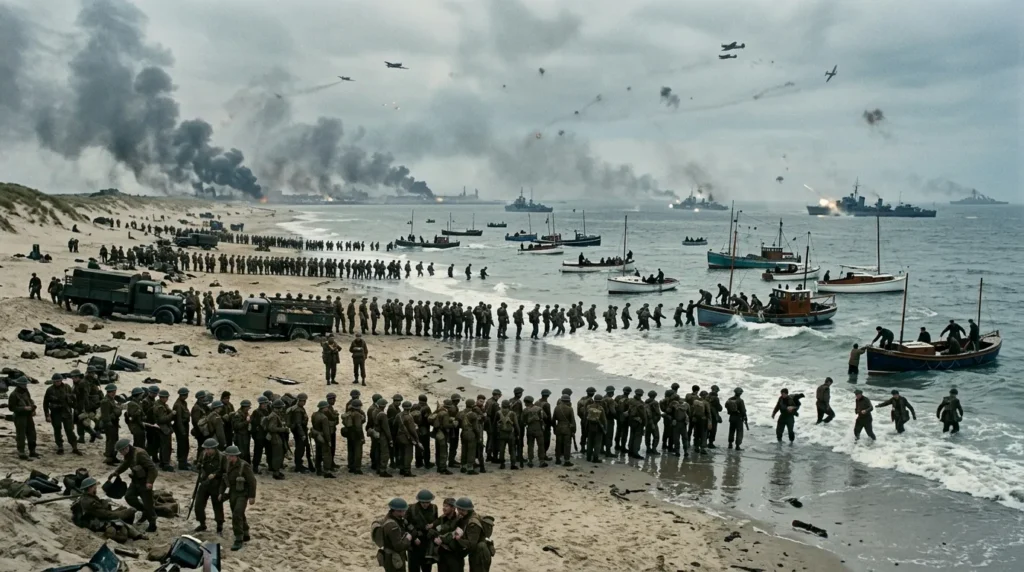
The story is based on the real evacuation from Dunkirk during World War II. Allied troops were trapped in northern France as German forces advanced rapidly in 1940. Naval vessels and civilian craft then helped carry troops across the Channel. Viewers who enjoy this period on screen may also like SAS Rogue Heroes, which dramatises other Second World War operations.
The film is not a detailed documentary about Operation Dynamo. It compresses events and uses fictional characters to place viewers inside the evacuation. It prioritises the physical experience of waiting, escaping, flying, sailing, and surviving.
One important historical element is the role of civilian vessels. The Moonstone represents the small boats associated with the evacuation effort. Their inclusion connects the military operation with the civilian response remembered in Britain.
The film also avoids turning the evacuation into a simple military victory. Characters repeatedly confront the fact that they are retreating from France. Survival becomes meaningful because the troops can return home and keep the war going.
Why the Sound and Music Feel So Intense
Hans Zimmer’s score drives the film’s tension. Music often seems to push scenes forward even when characters are standing still. The soundtrack works alongside gunfire, aircraft engines, explosions, waves, and mechanical sounds.
Nolan also suggests a ticking clock throughout the score. That creates the feeling that time is constantly running out. It suits a story where tides, fuel, enemy attacks, and departing ships determine survival.
The sound can make relatively restrained images feel frightening. The BBFC specifically highlights sustained wartime threat and intense sequences in its content advice. Blood and visible injury remain limited compared with many modern war films.
That combination matters for UK viewers checking the 12A certificate. The film is not especially graphic, but its atmosphere can be severe. Younger viewers may find the bombing, drowning risks, enclosed spaces, and constant danger disturbing.
Why the Cinematography Still Stands Out
Cinematographer Hoyte van Hoytema shot much of the production using large-format film, including IMAX photography. Wide images make the beach appear enormous while also exposing how vulnerable the soldiers are. Aircraft sequences use open skies and physical movement to create a different kind of tension.
The film relies heavily on practical filmmaking rather than making every major image feel digitally constructed. Real locations, boats, aircraft work, crowds, water, and large-scale sets give scenes physical weight. That approach helps the evacuation feel immediate rather than distant.
Large-format presentation also changes the scale of apparently simple moments. A lone aircraft crossing the sky can dominate the frame. Rows of soldiers waiting on an exposed beach can feel equally imposing.
For viewers with access to an IMAX presentation, the expanded imagery can add impact. The story remains understandable on television, though. Its editing and sound still carry much of the tension on smaller screens.
Dunkirk Ending Explained
The final section brings the three timelines together around the evacuation. Civilian boats reach the stranded troops while RAF pilots continue protecting them from above. Several central characters finally make their way back towards Britain.
Farrier stays in the air after his fuel runs low. He continues defending the beach before landing beyond Allied control. His final actions underline the film’s recurring idea that survival often depends on another person taking greater risks.
Back in Britain, returning soldiers fear they will be treated as failures because they retreated. Instead, they encounter relief and gratitude. Tommy reads Winston Churchill’s famous wartime words from a newspaper as the film closes.
The ending does not pretend that the war has been won. It presents the evacuation as survival during a disastrous military situation. That distinction gives the conclusion its mixture of relief, exhaustion, uncertainty, and resolve.
Was the Film Successful?
The production received strong critical attention after its 2017 release. Reviewers frequently highlighted its direction, cinematography, editing, sound, and unusual narrative structure. Its relatively sparse dialogue also distinguished it from more character-driven war dramas.
The film earned awards recognition at the 2018 Academy Awards. The film received eight Oscar nominations, including Best Picture and Best Director (Nolan). It won three awards for Film Editing, Sound Editing, and Sound Mixing.
Those categories reflect what makes the production distinctive. Editing connects timelines that operate at different speeds, while sound creates much of the constant pressure. Neither element works independently from the film’s visual storytelling.
Is Dunkirk Suitable for Children in the UK?
The film carries a 12A certificate in the UK. The BBFC identifies sustained threat, intense sequences, moderate violence, and strong language among its classification concerns. Its home-entertainment guidance also mentions limited injury detail and some dead bodies.
Parents should not assume limited blood means limited intensity. Characters face bombing, gunfire, sinking ships, drowning, fire, and confinement. The soundtrack can make these situations particularly stressful for sensitive younger viewers.
For older children interested in Second World War history, the film can prompt useful discussion. Parents can explain that the central characters are fictionalised within a real historical event. They can also discuss why an evacuation became such an important British wartime story.
Is Dunkirk Worth Watching Today?
The Dunkirk movie 2017 remains distinctive because it does not behave like a standard historical drama. There are no lengthy strategy meetings or conventional character biographies. The audience learns mainly by watching people react to danger.
That approach will suit viewers who prefer visual storytelling and sustained suspense. People wanting extensive dialogue or detailed historical explanation may find it emotionally distant. The film expects viewers to understand much of its context through action and imagery.
Its relatively short running time also keeps the story concentrated. At roughly 106 minutes, it moves quickly compared with many large historical epics. Few scenes exist only to explain information already visible on screen.
For UK audiences, the subject carries particular historical significance. Yet the film works best when viewed as a survival drama rather than a patriotic history lesson. Its strongest moments focus on fear, duty, endurance, and ordinary people responding to extraordinary circumstances.
Frequently Asked Questions
Is Dunkirk based on a true story?
Yes, the film is based on the real 1940 evacuation of Allied troops from northern France. The film uses its central characters to dramatise different experiences during that operation. Viewers should treat it as historical drama rather than a complete documentary account.
Who directed the Dunkirk movie 2017?
Christopher Nolan wrote and directed the film. He also produced it alongside Emma Thomas. The production continued his interest in non-linear storytelling, large-format photography, and practical filmmaking techniques.
How long is the film?
The standard theatrical version runs for roughly 106 minutes. Some sources list it as one hour and 46 minutes, while some presentations run closer to 107 minutes. It is therefore shorter than several other Nolan features.
What is the UK age rating?
The film has a 12A certificate in the UK. Its classification reflects sustained threat, intense wartime scenes, moderate violence, and some strong language. Parents should consider the film’s tension as well as its limited graphic content.
Did Harry Styles act in the film?
Yes, Harry Styles plays British soldier Alex. The role was his feature-film acting debut. He appears alongside Fionn Whitehead, Aneurin Barnard, and several established actors.
How many Oscars did it win?
The film won three Academy Awards. It won for Film Editing, Sound Editing, and Sound Mixing. It received eight nominations in total, including Best Picture and Best Director.
Final Takeaway
The film succeeds by making evacuation feel immediate rather than presenting history as a sequence of dates. Its three timelines show the crisis from the beach, the Channel, and the sky. Sparse dialogue leaves sound, editing, cinematography, and physical action to carry much of the story.
For viewers exploring Christopher Nolan’s films or modern Second World War cinema, this remains an important title to revisit. UK audiences also have the historical context behind its central event close to home. Watch it with good sound, then read about Operation Dynamo to separate the film’s dramatic choices from the wider history.