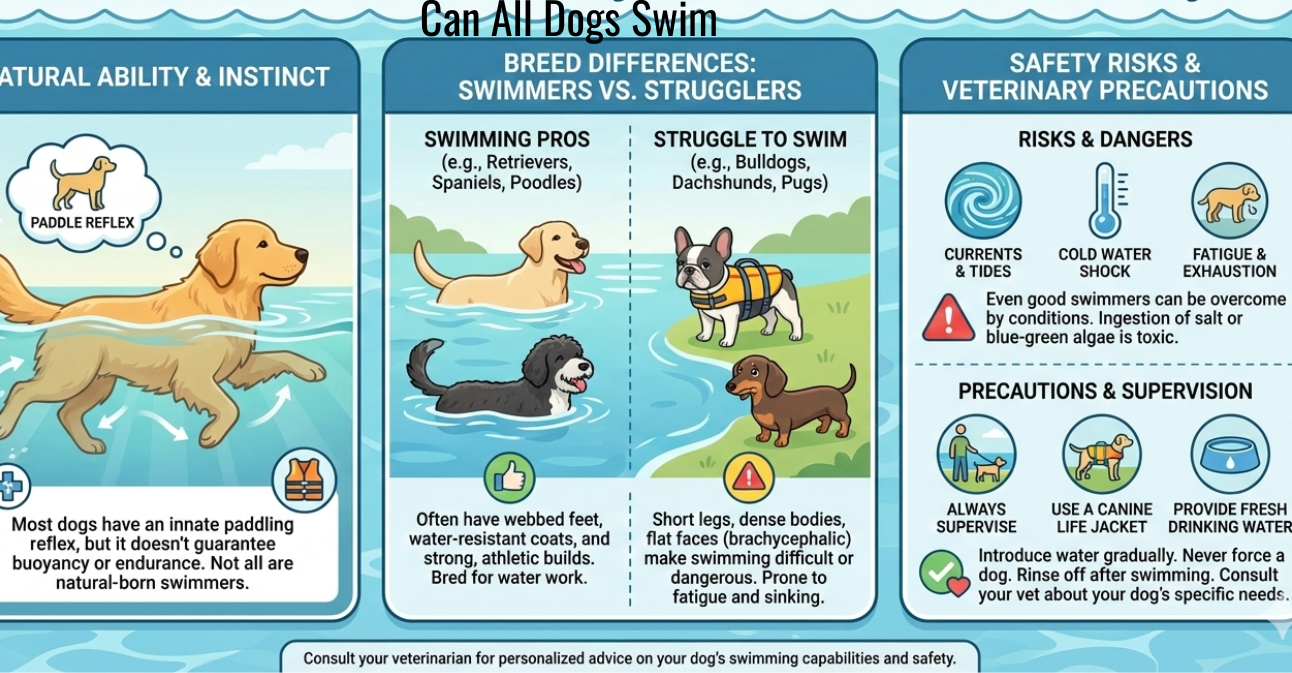
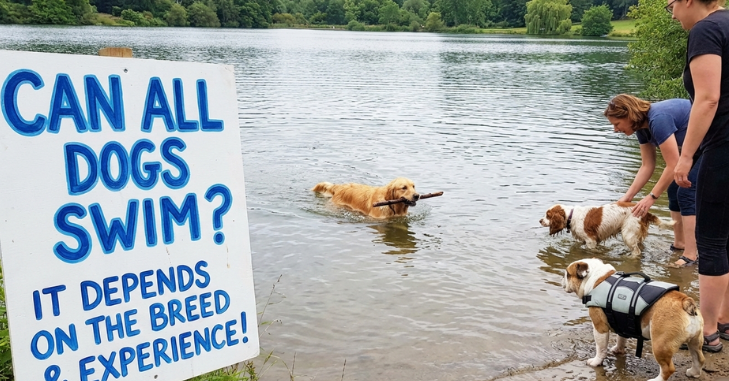
No, not all dogs can swim. Most healthy dogs can perform a doggy paddle for a short time, but the ability to swim safely depends on body shape, chest depth, leg length, coat type, age and health. Brachycephalic breeds such as Bulldogs, Pugs and French Bulldogs are genuinely poor swimmers and can sink within seconds, while Basset Hounds, Dachshunds and heavy-chested breeds struggle to keep their heads clear of the surface.
The belief that every dog is a natural swimmer causes real harm every summer. Dogs drown in garden pools, in fast-flowing British rivers and in cold coastal water, often while the owner is standing a few metres away. This guide sets out which breeds swim well, which do not, why anatomy decides the outcome, how to spot a dog in trouble, and how to introduce any dog to water safely. It is general information — a vet who knows your dog should advise on their individual fitness for swimming.
Why the “All Dogs Can Swim” Myth Persists
The myth comes from a genuine observation: place almost any conscious dog in water and its legs will begin to paddle. That reflex is real, but it is a survival response, not evidence of competence. A paddling dog with a heavy chest, short legs and a flat face is generating motion without generating lift, which is exactly how dogs drown.
Three further misconceptions do most of the damage. The first is that a dog that swam once will always swim well — in fact stamina drops sharply with age, weight gain and joint disease. The second is that dogs self-regulate and will stop when tired; many retrievers will fetch until they are physically incapable of returning to shore. The third is that calm-looking water is safe, when cold shock, undertow and blue-green algae are the risks that actually kill dogs in the UK.
The Anatomy That Decides Whether a Dog Can Swim
Swimming is a buoyancy and leverage problem. Four physical factors determine the outcome.
- Chest-to-hindquarter ratio. Dogs with heavy, deep chests and light rear ends float nose-down. Bulldogs and Basset Hounds have most of their mass forward, so the head is the first thing to submerge.
- Leg length and reach. Long-limbed dogs generate propulsion and lift with each stroke. Short-legged breeds paddle rapidly with little forward movement and tire quickly.
- Muzzle length. A long muzzle keeps nostrils above water even when the body sits low. A flattened muzzle sits at the waterline, so a small wave is enough to flood the airway.
- Coat and body fat. Double coats trap air and add insulation, which is why Labradors and Newfoundlands float higher and cope with cold water. Single-coated, lean breeds such as Greyhounds and Whippets have low body fat and lose heat rapidly.
Webbed feet matter less than people assume. Most dogs have some webbing; strong swimmers such as the Newfoundland and Portuguese Water Dog simply have more of it, alongside the body shape to use it.
Breeds That Swim Well
- Newfoundland: Bred for water rescue in Canada, with a water-resistant double coat, pronounced webbing and enormous lung capacity. Historically used to haul lines to stricken boats.
- Labrador Retriever: The classic all-rounder. An otter-like tail acts as a rudder, the coat is oily and water-shedding, and the breed was developed to retrieve from cold water.
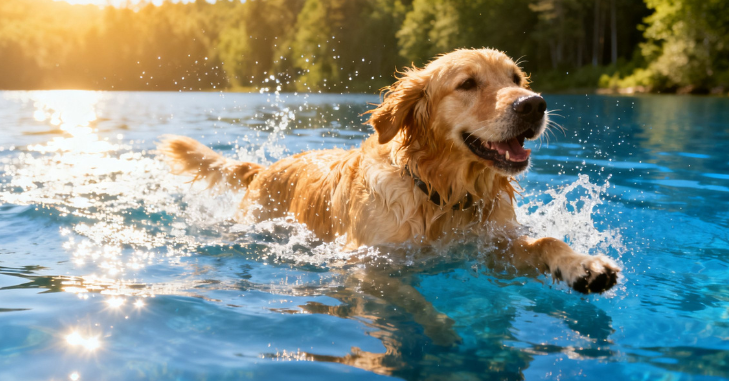
- Golden Retriever: Similar build and drive to the Labrador, with strong stamina and a natural retrieve instinct that keeps them swimming happily.
- Portuguese Water Dog: Developed to work alongside fishing crews, with a curly single coat and exceptional agility in water.
- Irish Water Spaniel and Standard Poodle: Both are historic water retrievers. The Poodle’s traditional clip originated as a practical way to keep joints warm while swimming.
- Chesapeake Bay Retriever and Spanish Water Dog: Both cope well with cold and rough conditions thanks to dense, oily coats.
Breeds That Struggle or Should Not Swim
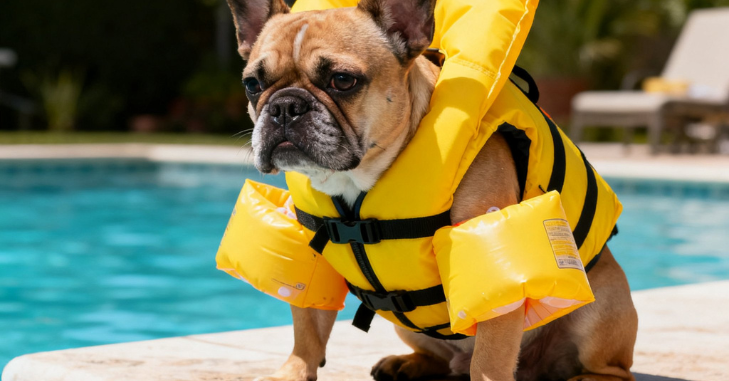
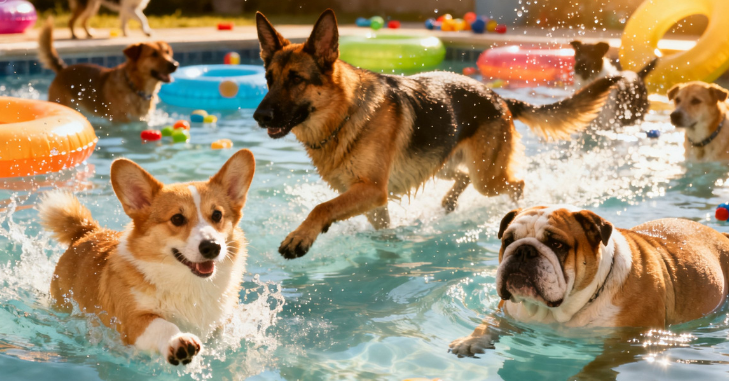
- Bulldog and French Bulldog: Heavy front, short legs, flat face and compromised airway. These breeds frequently sink rather than float and should never be in water without a buoyancy aid and close supervision.
- Pug: The same brachycephalic problems with even less muscle mass to compensate.
- Basset Hound: Very heavy bone, disproportionately short legs and long ears that fill with water.
- Dachshund: Long spine, short limbs. Many can paddle briefly, but the swimming posture places real strain on a back already prone to intervertebral disc disease.
- Boxer and Boston Terrier: Shortened muzzles and low body fat make sustained swimming difficult.
- Greyhound and Whippet: Physically capable but very lean, with minimal insulation. They chill fast in British water and many actively dislike it.
- Shih Tzu, Pekingese and Maltese: Small, flat-faced or heavily coated. A soaked long coat becomes extremely heavy.
Breed and Swimming Ability Compared
| Breed | Swimming ability | Main limiting factor | Buoyancy aid needed? |
| Newfoundland | Excellent | None; overheating on land | No |
| Labrador Retriever | Excellent | Overexertion when retrieving | No, but useful in open water |
| Golden Retriever | Excellent | Stamina in older dogs | Optional |
| Standard Poodle | Very good | Coat waterlogging if unclipped | Optional |
| Border Collie | Good | Cold tolerance | Optional |
| Cocker Spaniel | Good | Ear infections | Optional |
| Greyhound | Fair | Very low body fat | Recommended |
| Dachshund | Poor | Spinal strain, short legs | Essential |
| Basset Hound | Poor | Dense bone, heavy front | Essential |
| Boxer | Poor | Shortened muzzle | Essential |
| Pug | Very poor | Brachycephalic airway | Essential; avoid deep water |
| French Bulldog | Very poor | Dense body, flat face | Essential; avoid deep water |
| Bulldog | Very poor | Front-heavy, sinks | Essential; avoid deep water |
Why Flat-Faced Dogs Are at Particular Risk
Brachycephalic breeds have a shortened skull but a normal volume of soft tissue, which crowds the airway. On land this shows as snoring, snorting and heat intolerance. In water it becomes an emergency. Their nostrils sit only a centimetre or two above the surface, they cannot open their mouths wide to breathe without taking water in, and the effort of swimming demands far more oxygen than their airway can deliver. Add a stiff-legged paddle, a dense heavy body and low buoyancy, and the margin for error disappears.
If you own a flat-faced breed, the safest position is that deep water is off-limits. Shallow paddling in a supervised, shallow pool with a well-fitted buoyancy aid, for a few minutes only, is the sensible ceiling.
Health Conditions That Affect Swimming Ability
Breed is only half the picture. A Labrador with advanced hip dysplasia is a worse swimmer than a fit crossbreed. Check with your vet before letting a dog swim if any of the following apply.
- Hip or elbow dysplasia and arthritis: Swimming is often recommended as low-impact therapy, but only under controlled conditions such as canine hydrotherapy, not in a cold river.
- Intervertebral disc disease: Common in Dachshunds and other long-backed breeds. The extended swimming posture can aggravate it.
- Heart disease: Swimming is strenuous cardiovascular exercise. Dogs with murmurs or diagnosed cardiac conditions need veterinary clearance.
- Epilepsy: A seizure in water is usually fatal. Affected dogs should not swim unsupervised or in deep water.
- Chronic ear disease: Water entering the canal worsens otitis externa, a frequent problem in Cocker Spaniels and other drop-eared breeds.
- Obesity: Overweight dogs float higher but tire far faster and overheat more readily.
Can Puppies Swim?
Puppies should not be treated as small adults in water. Their coordination is immature, so the paddle is inefficient and often panicked. Their stamina is minimal — a puppy may be exhausted after a minute. They also lose body heat much faster than adult dogs because of a high surface-area-to-mass ratio and thin coats, so hypothermia can set in quickly even in water an adult finds comfortable.
Most vets suggest waiting until a puppy has completed its vaccination course and is physically well grown before introducing open water. Start in a shallow paddling pool, keep sessions to two or three minutes, and always let the puppy choose to enter rather than lifting it in.
Signs a Dog Is Struggling in Water
Dogs rarely thrash or bark when drowning. The signs are quiet and easy to miss.
- Vertical body position with the head tipped back and front paws slapping the surface.
- Nose repeatedly dipping below the waterline between strokes.
- Wide, fixed eyes and a closed, tense mouth rather than an open panting mouth.
- Rear end sinking so the dog is almost upright in the water.
- Silent, frantic paddling with no forward progress.
- Excessive water swallowing, which can lead to hyponatraemia, a dangerous dilution of blood sodium.
Get the dog out immediately, dry and warm it, and contact a vet if it coughs, retches, breathes rapidly, becomes lethargic or seems disoriented in the following 24 hours. Delayed complications from inhaled water are a genuine risk and are not always obvious at the poolside.
Pools, Lakes, Rivers and the Sea Compared
| Environment | Main hazards | Precautions |
| Garden or swimming pool | Chlorine irritation, no visible exit, steep sides | Teach the exit route, rinse afterwards, fence when unsupervised |
| Lake or pond | Blue-green algae, leptospirosis, hidden debris | Avoid scummy or discoloured water, keep vaccinations current |
| River or canal | Current, cold shock, steep banks with no exit | Check for an easy exit downstream, avoid after heavy rain |
| Sea | Rip currents, waves, salt ingestion, jellyfish | Stay in shallow water, rinse off salt, never throw toys out to sea |
| Hydrotherapy pool | Minimal, supervised | Best option for dogs with joint disease |
Blue-green algae is the hazard most UK owners underestimate. Blooms typically appear on still fresh water in warm weather, can be fatal within hours of ingestion, and there is no antidote. If water looks like green paint, has a surface scum or smells foul, keep the dog out of it and away from the shoreline.
How to Introduce a Dog to Water Safely
- Fit a buoyancy aid. A proper canine life jacket with a handle on the back lets you lift the dog out in one movement. Use one for any first swim, any open water, and permanently for poor swimmers.
- Start in ankle-deep water with a gently shelving entry, and let the dog walk in of its own accord. Never throw a dog in; a single frightening experience can create a lifelong aversion.
- Support the hindquarters on the first few strokes. Many first-time swimmers paddle only with the front legs and hang vertically until they learn to engage the rear.
- Keep sessions short — five minutes to begin with. Swimming is far more tiring than the equivalent time spent running.
- Teach the exit before the entry. Show the dog where the steps or ramp are and reward it for using them, every time.
- Rinse and dry afterwards, paying particular attention to ears, and check between the toes for cuts from stones or shells.
The Verdict
Some dogs are outstanding swimmers, most are competent for short periods in calm conditions, and a significant minority are physically incapable of staying afloat. Judge the individual dog in front of you rather than the label on the breed, fit a buoyancy aid whenever there is any doubt, supervise every session, and treat cold water, currents and algae as the real dangers they are. Small breeds in particular deserve extra caution, as covered in our guide to the smallest dog breeds. Want to know more? Check out our Pets category.
Frequently Asked Questions
Can all dogs swim naturally?
No. Almost all dogs will paddle instinctively when placed in water, but paddling is not the same as swimming. Body shape decides whether that paddling keeps the dog afloat. Deep-chested, short-legged and flat-faced breeds such as Bulldogs, Pugs, Basset Hounds and Dachshunds often sink nose-first despite paddling hard, so they need a buoyancy aid and constant supervision, or should avoid deep water entirely.
Which dog breeds cannot swim?
Bulldogs, French Bulldogs and Pugs are the highest-risk breeds because their shortened airways and front-heavy bodies make sustained swimming dangerous. Basset Hounds, Dachshunds, Boxers, Boston Terriers, Shih Tzus and Pekingese also swim poorly. Lean sighthounds such as Greyhounds and Whippets can physically swim but chill very quickly in British water and usually need a buoyancy aid.
At what age can a puppy start swimming?
Most vets advise waiting until the puppy has finished its vaccination course and is reasonably well grown before introducing open water, since puppies have poor coordination, very little stamina and lose body heat rapidly. Begin in a shallow paddling pool with sessions of two or three minutes, let the puppy walk in voluntarily, and dry it thoroughly afterwards.
How do I know if my dog is drowning?
Look for a vertical body position with the head tipped back, the nose dipping below the surface between strokes, the rear end sinking, wide fixed eyes, and frantic front-paw slapping with no forward movement. Drowning dogs are usually silent. Lift the dog out immediately, dry and warm it, and contact a vet if it coughs, retches, breathes rapidly or seems disoriented in the next 24 hours.
Is swimming good exercise for dogs?
For most healthy dogs, yes. It is low-impact, builds cardiovascular fitness and is often recommended by vets as hydrotherapy for arthritis and post-operative recovery. However, it is far more tiring than running for the same duration, so keep early sessions to about five minutes. Dogs with heart disease, epilepsy, spinal problems or chronic ear infections should be cleared by a vet first.
Do dogs need life jackets?
Poor swimmers such as Bulldogs, Pugs, Dachshunds and Basset Hounds should always wear one in water. So should any dog on a boat, in open sea or river conditions, or swimming for the first time. Choose a canine buoyancy aid with a sturdy grab handle over the shoulders so you can lift the dog out quickly, and check the fit so it cannot slip over the head.