Trent Alexander-Arnold’s net worth is most commonly estimated at between £40 million and £60 million, though no verified figure exists and no published estimate is drawn from his actual accounts. The bulk of it comes from playing contracts — a reported £180,000 a week at Liverpool in his final years, followed by the six-year Real Madrid deal signed in May 2025 — plus long-running commercial partnerships with Under Armour, Red Bull and Therabody, image rights held through a personal company, and bonuses from one of the most decorated trophy hauls of any English player his age.
Two things have changed since most articles about his wealth were written, and both matter financially. He is no longer a UK taxpayer, which alters the arithmetic on everything he earns from now on. And in May 2026 he was left out of England’s World Cup squad, removing the single largest source of commercial visibility available to an English footballer. This page works through what he has plausibly earned, what tax and costs remove from it, what the move to Spain did to his position, and why published footballer net worth figures are systematically overstated.
Why the Estimates Vary So Widely

Net worth is not a published statistic for footballers. Clubs do not disclose individual salaries; wage figures reach the press through agents, leaks and inference. Endorsement values are commercially confidential. Investments and property are private unless a company filing makes them visible. Everything you read is therefore an estimate built on estimates.
Four specific distortions make published figures unreliable:
- Gross is quoted as if it were net. A reported £180,000 a week is a gross contractual figure. What reaches the player’s account is a little over half that once UK income tax and National Insurance are applied.
- Career earnings are confused with net worth. Total money passing through a career is not wealth. Wealth is what remains after tax, agent commission, living costs and losses.
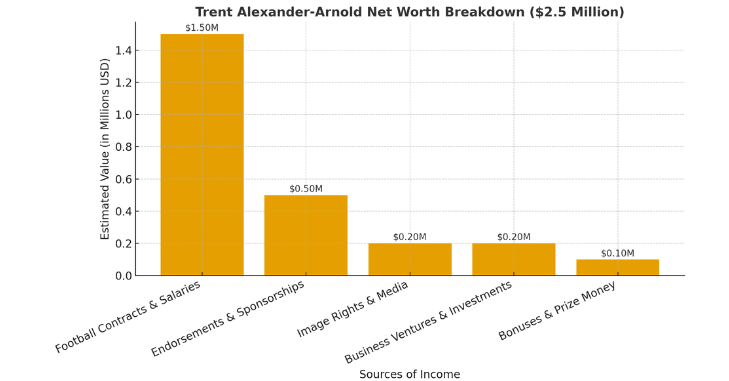
- Currencies are mixed carelessly. The same source will state a figure in pounds in one paragraph and dollars in the next, producing a swing of 25% or more for no reason. If you have seen $2.5 million attached to his name, it is wrong by more than an order of magnitude and appears to have been copied between content farms without anyone checking it.
- The tax jurisdiction is ignored. Almost every estimate online still models him as a UK earner. He has been resident in Spain since June 2025, on a different rate structure with an annual wealth tax the UK does not levy.
What He Has Plausibly Earned
Working from widely reported wage figures rather than guesses, the shape of his playing income looks roughly like this. Every figure here is an approximation from press reporting, not a confirmed contract value.
| Period | Club | Reported weekly wage | Approximate gross for the period |
| 2016–2018 | Liverpool (breakthrough years) | Rising from modest first-team terms | £2m–£4m |
| 2018–2021 | Liverpool (post-Champions League deal) | Around £40,000–£75,000 | £8m–£12m |
| 2021–2025 | Liverpool (long-term deal signed July 2021) | Around £180,000 | £35m–£40m |
| 2025–2031 | Real Madrid (six-year contract) | Reported low-to-mid eight figures a year | Ongoing |
That puts gross career playing income to date plausibly in the £55 million to £70 million range, before bonuses. Add several seasons of trophy and appearance money and the gross rises further.
Now subtract. As a UK resident on the additional rate he paid 45% income tax on the great majority of that, plus National Insurance at 2% above the upper earnings limit. Agent and representation fees typically run at several per cent of a contract’s value. Financial and legal advice, insurance and the ordinary costs of a high-income life take more. A realistic net figure retained from UK playing wages is close to half the gross — call it £24 million to £30 million — before any endorsement income or investment growth.
That arithmetic is why an estimate in the £40 million to £60 million bracket is defensible at the lower end and optimistic at the upper end. It is also why figures published without any deduction for tax should be read as career turnover rather than wealth.
The Real Madrid Move: The Numbers That Are Actually Documented
Unusually for a net worth topic, part of this transfer is on the record. Alexander-Arnold’s Liverpool contract was due to expire on 30 June 2025 and he had already announced he would leave. Real Madrid wanted him registered in time for the expanded Club World Cup in the United States, so they paid a fee to release him early. Liverpool sources put that fee at €10 million (about £8.4 million) paid up front, while sources at the Spanish club indicated a lower figure. He signed a six-year deal running to 2031, with a buy-out clause set at €1 billion — roughly £840 million — which is now standard practice at Real Madrid rather than a statement about any individual player.
He left Liverpool having made 354 appearances, scoring 23 goals and recording 92 assists, with two Premier League titles, the Champions League, the FIFA Club World Cup, the UEFA Super Cup, the FA Cup and the League Cup. He took the number 12 shirt at Madrid rather than his Liverpool 66, and the name on the back reads simply “Trent” to avoid confusion for Spanish supporters.
Financially, a near-free transfer is usually good for the player. With almost no fee to amortise, a club can afford a larger signing-on bonus and higher wages — money that would otherwise go to the selling club goes to the player instead. That is the single strongest argument for his net worth having risen rather than stalled since 2025, even though his football has not gone to plan.
What Spanish Residency Does to the Arithmetic
This is the part almost every net worth page omits, and it cuts both ways.
Spain’s special expatriate regime, commonly called the Beckham Law, has been closed to professional athletes since 2010, so he pays ordinary Spanish rates rather than the flat expatriate rate. Income tax in Spain combines a state scale with a regional one, and the Madrid region sets the lowest regional rates in the country: the top combined marginal rate there lands at around 45%, broadly comparable to the UK additional rate and slightly better once UK National Insurance is included.
The offsetting factor is that Spain taxes wealth as well as income. The Patrimonio net wealth tax is progressive on assets above a threshold, and although the Madrid region rebates its own version, a state-level solidarity levy on large fortunes was introduced specifically to capture high-net-worth residents in regions that had rebated theirs. The United Kingdom has no equivalent. For a footballer whose accumulated assets run well into eight figures, an annual charge on the stock of wealth, rather than just the flow of income, is a structural difference that compounds over a six-year contract.
Net effect: slightly better on earnings, meaningfully worse on the money already banked. Anyone quoting a single net worth figure that has not accounted for this is guessing twice over.
Endorsements: Correcting a Common Error
A great many articles list adidas as his boot sponsor. That is wrong. Alexander-Arnold has been an Under Armour athlete since 2018, when he became one of the brand’s first high-profile football signings, and his named commercial partners also include Red Bull and Therabody — all three are publicly identified as sponsors through their involvement in his own foundation.
Boot and apparel deals for a player of his profile typically run into seven figures annually at the top tier, with performance and appearance clauses on top, though no specific value has ever been disclosed. Beyond footwear he has appeared in fashion and lifestyle campaigns, and image rights — the entitlement to earn from commercial use of his name and likeness — are usually held through a personal company and negotiated separately from the playing contract, which is one reason headline wage figures understate total income.
Two things now weigh on the commercial side. First, the manner of his Liverpool exit damaged his standing with a large and commercially valuable domestic fanbase; when he returned to Anfield with Real Madrid in November 2025 he was booed throughout his nine-minute appearance, and a mural of him in the city was vandalised in the days before the match. Second, and more consequentially, he is currently outside the England squad.
The 2026 Picture: Two Difficult Seasons
His first full season in Spain was not what either side expected.
| Season | Competition | Appearances | Goals |
| 2024–25 (Club World Cup only) | FIFA Club World Cup | 5 | 0 |
| 2025–26 | La Liga | 21 | 0 |
| 2025–26 | Champions League | 9 | 0 |
| 2026–27 (to mid-September) | La Liga and Champions League | 4 | 0 |
| Real Madrid total | All competitions | 39 | 0 |
Thirty-nine appearances without a goal is a striking return for a player who scored 23 for Liverpool, and the assist numbers have been modest by his own standards. An injury sustained in the away win at Athletic Bilbao in December 2025 cost him part of the campaign, and he competed for the position rather than owning it. Real Madrid finished the 2025–26 season second in La Liga, went out of the Copa del Rey in the round of 16, lost the Supercopa de España final and were eliminated in the Champions League quarter-finals: a second successive trophyless year for the club. Their 2025 Club World Cup campaign, the tournament he was signed early to play in, ended before the final, with Chelsea taking the title.
Xabi Alonso, the manager he moved to work with, is no longer in charge. José Mourinho took over for 2026–27, and long-serving captain Dani Carvajal — the player whose position Alexander-Arnold was signed to inherit — departed in May 2026 after 23 years at the club. Four appearances into the new season, the situation is unresolved rather than settled.
Missing the World Cup, and What It Costs
On 22 May 2026, Thomas Tuchel named England’s squad for the World Cup and Alexander-Arnold was not in it. Reece James and Djed Spence were the right-backs selected. He ended his England career to date on 34 caps and four goals, his most recent appearance having come in June 2025.
Commercially this is the most significant financial event of his year, and it is not close. International football adds relatively little directly to a footballer’s income — appearance fees and tournament bonuses are small next to club wages — but a World Cup is the one moment when a domestic audience that does not follow La Liga sees an English player for six weeks. Squad membership drives the boot campaigns, the supermarket adverts and the broadcast tie-ins that make up the commercial half of an England international’s income. Missing it at 27, in the summer when he should have been at his commercial peak, removes a cycle of earnings that does not come round again until 2030.
It also changes how the next contract renegotiation looks, whenever it comes. A player’s leverage is a function of what a club can sell as well as what he does on the pitch.
Career Timeline and Honours
Born on 7 October 1998 in West Derby, Liverpool, Alexander-Arnold turns 28 in October 2026. He joined the Liverpool academy at six, converted from wide midfielder to right-back inside the academy, captained age groups through the youth system, and made his senior debut in October 2016.
| Year | Milestone |
| 2016 | Senior Liverpool debut aged 18 |
| 2018 | Youngest player to start a Champions League final for Liverpool; England debut and first goal; named in the World Cup squad |
| 2019 | Champions League winner; UEFA Super Cup and Club World Cup follow |
| 2020 | Premier League title, Liverpool’s first in 30 years; PFA Young Player of the Year and inaugural Premier League Young Player of the Season |
| 2022 | FA Cup and League Cup double; youngest player to win six major trophies for an English club, at 23 years and 219 days |
| 2023 | Founds The After Academy |
| 2024 | League Cup; starts in central midfield as England open Euro 2024, reaching the final |
| 2025 | Second Premier League title, then joins Real Madrid for a reported €10m early-release fee |
| 2026 | Omitted from England’s World Cup squad; Madrid finish 2025–26 trophyless |
The statistical case for him remains unusual for a defender. He set the record for most assists by a defender in a single Premier League season and finished his Liverpool career as the competition’s highest-assisting defender, with 92 assists in all competitions for the club. Very few full-backs in the history of the English game have created chances at that rate, and it is the specific reason he commanded the wages he did: he was priced as a creative player who happens to defend, not as a defender.
How He Compares
Context helps make sense of the numbers. At his reported Liverpool peak he sat within the club’s top wage bracket but below the very highest-paid Premier League players, whose packages reached £300,000 a week and beyond. Across European football, the largest earners at Real Madrid, Paris Saint-Germain and in the Saudi Pro League operate on a different scale entirely, with Saudi contracts running to several times what any European club pays.
Among English internationals of his generation his earnings place him in the upper group without being an outlier. What distinguishes his position is longevity of exposure rather than peak wage: he was a first-choice player at an elite club from the age of 20, so he has been earning senior money for far longer than most players his age. The same estimation problems apply across the sport — reported figures for managers such as Eddie Howe vary between sources for exactly the same reasons, and so do published estimates for public figures whose finances genuinely are partly documented, such as King Charles III.
Playing Style and Why Clubs Pay for It
The commercial value of a player follows what they can do that others cannot, and in his case the distinguishing skill is delivery. His range of passing — the diagonal switch, the clipped ball in behind, the whipped near-post cross — generates chances from positions where most full-backs recycle possession. He is also one of very few defenders in the modern game trusted with corners and free kicks at an elite club.
The trade-off has been debated for years. Playing high and wide leaves space behind, and opponents have targeted it; the criticism of his defending has followed him from Merseyside to Madrid. Under Arne Slot at Liverpool he was increasingly used in an inverted role, stepping into midfield in possession rather than overlapping, which reduced that exposure. Real Madrid signed a player capable of operating both ways, and a large part of the 2025–26 difficulty was that the hybrid role which made him exceptional in England has no exact equivalent in Xabi Alonso’s or Mourinho’s set-ups.
Off the Pitch

Alexander-Arnold founded The After Academy in April 2023, funding it for an initial five years to support young players released by football academies — a group with a well-documented rate of leaving the game entirely after a decade inside a club system that ends abruptly at 18. It runs with the co-operation of the PFA and his sponsors. He has also been an ambassador since his mid-teens for the Liverpool charity An Hour for Others, and auctioned a pair of Black Lives Matter boots that raised £27,000 for the Nelson Mandela Foundation.
His brother Tyler has acted as his representative, an arrangement that keeps agent commission within the family rather than paying it to an external agency — a structural detail worth a meaningful amount over a career of this size. He is the nephew of John Alexander, the former Reading and Millwall player who went on to be Manchester United’s club secretary, and a keen chess player who lost an invitational exhibition match to world champion Magnus Carlsen in seventeen moves in 2018.
Reading Footballer Net Worth Figures Sensibly
- Check whether tax has been deducted. Most published figures ignore it entirely. In the UK, roughly half of a top footballer’s gross wage never reaches them.
- Check which country they live in. A player who moved jurisdictions has a different rate structure and, in Spain’s case, an annual wealth tax with no UK equivalent.
- Distinguish career earnings from current wealth. The two are routinely conflated and differ enormously.
- Treat endorsement values as guesses. Brands do not publish what they pay athletes — and check the brand is even right. The adidas claim attached to Alexander-Arnold across dozens of sites is simply an error.
- Watch for stale figures. A number written in 2022 and republished unchanged in 2026 misses four years of earnings, a move to another country and a World Cup omission.
- Be sceptical of precision. A figure quoted to the nearest hundred thousand implies access to information no journalist has.
The same caution applies to the career-statistics pages that feed these estimates, including for long-serving English full-backs such as Ashley Young, and to the match-by-match coverage of Liverpool’s European campaigns that established his reputation in the first place.
Frequently Asked Questions
What is Trent Alexander-Arnold’s net worth in 2026?
Published estimates commonly fall between £40 million and £60 million. No verified figure exists, since neither his contracts nor his investments are public, and most online estimates have not been updated for the fact that he has been a Spanish taxpayer since June 2025. Figures in the low single-digit millions are inconsistent with his reported wages and should be disregarded.
How much did Trent Alexander-Arnold earn at Liverpool?
His final Liverpool contract, signed in July 2021, was widely reported at around £180,000 a week gross, following earlier deals at lower figures. Across his Liverpool career that suggests gross playing income somewhere in the region of £50 million, before bonuses and before tax.
What fee did Real Madrid pay for him?
His Liverpool contract expired on 30 June 2025, so he could have moved on a free transfer. Real Madrid paid to release him early so he could play in the Club World Cup. Liverpool sources put the fee at €10 million, about £8.4 million, paid up front; Real Madrid sources suggested a lower amount. His six-year contract carries a €1 billion buy-out clause.
Who are Trent Alexander-Arnold’s sponsors?
Under Armour, not adidas, has been his boot and apparel partner since 2018. Red Bull and Therabody are also named commercial partners. The values of these deals are not disclosed publicly.
Did Trent Alexander-Arnold play at the 2026 World Cup?
No. He was left out of the England squad named by Thomas Tuchel on 22 May 2026, with Reece James and Djed Spence selected as the right-backs. He has 34 England caps and four goals, his last appearance coming in June 2025.
How has he performed at Real Madrid?
Modestly by his own standards. He has made 39 appearances across all competitions without scoring, was injured in December 2025, and Real Madrid finished the 2025–26 season without a trophy, second in La Liga and out of the Champions League at the quarter-final stage.
Is he the highest-paid full-back in the world?
Not by reported figures. He is among the best-paid defenders in European football, but the highest overall packages sit with a small group of forwards and with players in the Saudi Pro League, where wages have exceeded anything paid in Europe.
What does he do outside football?
He founded The After Academy in 2023 to support players released from football academies, and has been an ambassador for the Liverpool charity An Hour for Others since his teens. His brother Tyler represents him professionally.