King Charles III’s personal net worth is widely estimated at around £600 million to £640 million, making him one of the wealthiest people in Britain but nowhere near the richest. That figure covers his private wealth only — the income from the Duchy of Lancaster, the Sandringham and Balmoral estates, inherited art, jewellery, a stamp collection and investments. It deliberately excludes the Crown Estate, the Royal Collection and the occupied royal palaces, which are held in trust for the nation and cannot be sold.
Two things changed the picture in June 2026. For the first time in history, Buckingham Palace published the Sovereign’s personal tax bill: £11.7 million in 2023-24 and £12.9 million in 2024-25, more than £30 million since accession. And the Royal Trustees confirmed the Sovereign Grant will be cut from £137.9 million in 2026-27 to £99.9 million a year from 2027 to 2032 once the Buckingham Palace reservicing programme finishes. This page sets out what Charles actually owns, what the latest published accounts show, how the money is taxed, and how his position compares internationally — with every figure dated and sourced.

What Charles Owns Personally Versus What the Crown Holds
| Asset | Latest value | Owned personally? |
| Duchy of Lancaster | £687.3m net assets at 31 March 2026 | Held in right of the Crown; income to the monarch, capital not personally disposable |
| Sandringham Estate, Norfolk | £245m–£300m (estimated) | Yes, private property |
| Balmoral Estate, Aberdeenshire | £80m–£150m (estimated) | Yes, private property |
| Inherited investments and cash | Estimated £140m–£200m | Yes |
| Jewellery, art and the royal stamp collection | Tens of millions | Partly; much is held in trust |
| The Crown Estate | Returned £0.5bn net revenue profit to the Treasury in 2025/26 | No; profits go to the Treasury |
| The Royal Collection | Estimated £1bn+ | No; held in trust for the nation |
| Buckingham Palace, Windsor Castle | Not meaningfully valued | No; occupied royal palaces held in trust |
| The Crown Jewels | Estimated £3bn–£5bn | No; held in trust for the nation |
That distinction is the whole story, and it explains why published figures for royal wealth range from £600 million to £28 billion depending on what the writer chose to count. Only the middle block of that table is genuinely Charles’s. The Duchy of Lancaster sits awkwardly between the two: he receives its annual surplus, but he is effectively a trustee and cannot take the capital.
Charles inherited the bulk of his private fortune from Queen Elizabeth II in September 2022. Because it passed from one sovereign to the next, it was exempt from the 40% inheritance tax that would apply to any other estate of that size, under a 1993 agreement between the Queen and the government designed to prevent the monarchy’s private assets being eroded across successive short reigns.
What the 2026 Accounts Actually Show
Three separate sets of published accounts govern royal money, and they landed within a day of each other in late June 2026.
| Source | Period | Headline figure | Change |
| Sovereign Grant | 2025-26 | £132.1m (Core £72.1m, Reservicing £60m) | First increase since 2021-22 |
| Sovereign Grant | 2026-27 | £137.9m (Core £97.6m, Reservicing £40.3m) | Final tranche of reservicing funding |
| Sovereign Grant | 2027-2032 | £99.9m a year | Reset lower after reservicing ends |
| Duchy of Lancaster adjusted net surplus | Year to 31 March 2026 | £25.2m | Up 3.4% from £24.4m |
| Duchy of Lancaster net assets | 31 March 2026 | £687.3m | Up 1.3% from £678.7m |
| Crown Estate net revenue profit | 2025/26 | £0.5bn to the Treasury | £5bn over ten years |
| The King’s personal tax | 2024-25 | £12.9m | £11.7m in 2023-24; £30m+ since accession |
The tax disclosure is genuinely new. Until the 2025-26 Sovereign Grant Report was published on 25 June 2026, the Sovereign’s personal tax payment had never been made public, and estimates circulated for decades without any way of checking them. The Palace released it alongside a new summary document explaining the various sources of royal finance, which the Keeper of the Privy Purse, James Chalmers, framed as a transparency measure.
Where the Income Comes From
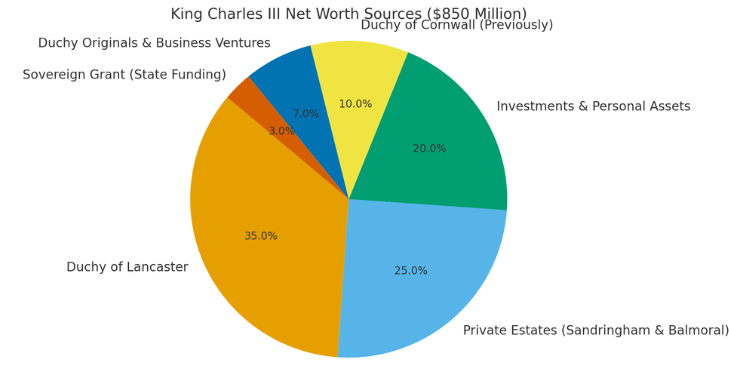
The Duchy of Lancaster
The Duchy is a private estate held in right of the Crown. Its 2026 report and accounts put it at 41,910 acres of rural land, 1.9 million square feet of mixed-use space and 96 miles of foreshore, spread across five rural surveys in Cheshire, Lancashire, Staffordshire, Yorkshire and the south, with a mineral portfolio running from South Wales to North Yorkshire. Yorkshire alone accounts for 15,117 acres across the Cloughton, Goathland, Marishes, Pickering and Pontefract estates.
The Savoy Estate in London, bordering the Strand, is the largest urban asset, with the wider portfolio including industrial property in Liverpool and Manchester. Revenue for the year to 31 March 2026 was £33.9 million, down £1.6 million, but the adjusted net surplus still rose 3.4% to £25.2 million, helped by lower bank interest after debt repayment in 2024/25. That surplus is the King’s principal private income, and he pays income tax on it voluntarily at the standard rate after deduction of official expenditure.
The Sovereign Grant
The Sovereign Grant funds official duties, staff, travel and the maintenance of occupied royal palaces. It is calculated as a percentage of Crown Estate profits from two years earlier. That percentage was cut from 25% to 12% in 2023, at the King’s stated wish, after offshore wind leasing sent Crown Estate profits sharply higher and an unchanged formula would have handed the Household a windfall.
In 2025-26 the grant was £132.1 million and net expenditure met by it was £117.2 million, up £32 million or 38% on the previous year. Over half — £67.5 million, or 51% — went on property maintenance, including £39.3 million on the Buckingham Palace reservicing programme in its penultimate year and a further £3.5 million of capital spending, mostly on two new lifts to improve accessibility. The Sovereign Grant Reserve rose to £21.2 million at 31 March 2026, with £52.6 million of reservicing commitments still authorised and contracted.
Critically, none of this is personal income and none of it can be spent privately. It is public funding for the institution, audited and reported annually. The Palace also confirmed in June 2026 that once reservicing finishes, the King and Queen will not make Buckingham Palace a personal residence, keeping it as the ceremonial centre of royal life and a heritage asset with increased public access.
The Duchy of Cornwall, now Prince William’s
Charles held the Duchy of Cornwall for over five decades as Prince of Wales, and it was his main income for most of his adult life, generating annual surpluses that grew to more than £20 million. On his accession it passed automatically to Prince William as Duke of Cornwall. It is no longer part of Charles’s finances, and its recent activity — affordable housing at Nansledan, regenerative farming partnerships, an annual Integrated Impact Report — belongs to William’s balance sheet, not his.
Private estates and investments
Sandringham, bought by the future Edward VII in 1862, and Balmoral, purchased by Prince Albert in 1852, are genuinely private and were inherited directly. Both operate commercially, with farming, forestry, holiday lettings and visitor operations. Alongside these sit inherited share portfolios, cash and a stamp collection assembled from George V onwards that is regarded as among the most valuable in the world. None of these assets is independently valued and published, which is why estimates for them vary by a hundred million pounds or more depending on the source.
Duchy Originals and commercial ventures
Charles founded Duchy Originals in 1990 to sell organic food produced on Duchy of Cornwall land. Since 2010 it has been licensed to Waitrose as Waitrose Duchy Organic, with proceeds directed to charity rather than to him personally. It remains one of the clearest examples of his long-standing interest in organic farming, which was regarded as eccentric when he began and mainstream long before he came to the throne.
How Royal Wealth Is Taxed
- Income tax is paid voluntarily on Duchy of Lancaster income and private investment income, after deducting official expenditure, under the arrangement introduced in 1993. The published figures — £11.7 million for 2023-24 and £12.9 million for 2024-25 — are the first hard numbers ever released.
- Inheritance tax does not apply to bequests from sovereign to sovereign, which is why the transfer from Elizabeth II to Charles attracted no charge. On an estate of roughly £370 million, a 40% charge would have been in the region of £150 million.
- Capital gains tax is paid voluntarily on private asset disposals.
- The Duchy of Lancaster itself does not pay corporation tax or capital gains tax, a long-standing exemption that draws regular criticism, particularly when set against its £687.3 million net asset base.
- The Sovereign Grant is public money, not taxable income, and its use is examined by the National Audit Office and reported to Parliament.
What the Money Buys: Output in 2025-26
The Sovereign Grant Report is one of the few places where cost and activity are reported side by side, which makes it the only defensible basis for arguing about value for money.
| Measure | 2025-26 |
| Engagements by The King and Queen | 708, over 100 more than the previous year |
| Engagements by all working members of the Royal Family | 2,273, in the UK and overseas |
| Palace events held | 827 |
| Guests attending those events | Almost 97,000 |
| Total payroll and other staff costs | £37m, up from £34.1m |
On a per-engagement basis the arithmetic is crude but instructive: the £72.1 million core grant against 2,273 engagements works out at roughly £32,000 each, though that treats palace maintenance, state visits and the entire Household as if they existed only to generate engagements. Critics and defenders both use this calculation and reach opposite conclusions, which is a reason to treat any single figure with suspicion.
How Charles Compares Internationally
| Monarch | Estimated personal wealth | Main source |
| King Maha Vajiralongkorn, Thailand | £25bn–£35bn | Crown Property Bureau assets transferred to personal ownership |
| Sultan Hassanal Bolkiah, Brunei | £15bn–£20bn | Oil and gas revenues |
| King Salman, Saudi Arabia | Estimated in the billions | State oil wealth |
| King Charles III, United Kingdom | £600m–£640m | Duchy of Lancaster surplus, private estates, inheritance |
| King Willem-Alexander, Netherlands | Around £150m | Inherited wealth and state allowance |
| King Felipe VI, Spain | Under £20m | State allowance; deliberately modest |
The Thai comparison is the instructive one, because it shows what happens when institutional assets are formally transferred into personal ownership — exactly the step British constitutional practice prevents. Charles controls assets worth vastly more than Vajiralongkorn’s on paper and owns a fraction as much.
Domestically the gap is just as stark. The Sunday Times Rich List published on 15 May 2026 found the UK’s 350 wealthiest individuals and families share £784 billion between them, with the top place alone at £38 billion. Against that, an estimate of £600 million to £640 million places the monarch a long way behind Britain’s leading industrial and property fortunes and in the same broad territory as successful entertainers — Gary Barlow’s net worth, for instance, sits in the tens of millions rather than the hundreds, but the order-of-magnitude point holds. The King’s financial position is better understood as custodial than personal: he controls, but does not own, the great majority of the assets associated with the monarchy.
Why the Estimates Disagree
Anyone comparing sources will find figures that cannot all be right. The main reasons are worth stating plainly.
- Scope. Some estimates fold in the Crown Estate, the Royal Collection and the palaces. That is how a £600 million figure becomes £28 billion. None of those assets can be sold, borrowed against or bequeathed privately.
- The Duchy of Lancaster. Its £687.3 million of net assets is sometimes counted as personal wealth and sometimes not. Treating the £25.2 million annual surplus as income but the capital as institutional is the more defensible approach.
- Unvalued private assets. Sandringham, Balmoral, the art, the jewellery and the stamp collection have no published valuations. Every figure for them is an outside estimate.
- Timing. Figures published before June 2026 predate the first disclosure of the King’s tax payments and the confirmation of the Sovereign Grant reset, so the funding picture in older articles is out of date.
The Path to the Throne

Charles Philip Arthur George was born at Buckingham Palace on 14 November 1948, the first child of Princess Elizabeth and Prince Philip. He became heir apparent at the age of three when his mother acceded in February 1952, and was created Prince of Wales in 1958, with the investiture held at Caernarfon Castle in 1969.
He was the first heir to the British throne to be educated at school rather than by tutors, attending Hill House, Cheam and Gordonstoun, before spending a term at Timbertop in Australia. He then read archaeology, anthropology and history at Trinity College, Cambridge, becoming the first British heir apparent to earn a university degree. He also served in both the Royal Air Force and the Royal Navy, qualifying as a jet pilot and later a helicopter pilot, and commanded the minehunter HMS Bronington in 1976.
He married Lady Diana Spencer at St Paul’s Cathedral in July 1981, in a ceremony watched by an estimated global television audience approaching 750 million. Their sons, Prince William and Prince Harry, were born in 1982 and 1984. The couple separated in 1992 and divorced in 1996; Diana died in a car crash in Paris in August 1997. Charles married Camilla Parker Bowles in a civil ceremony at Windsor Guildhall in April 2005.
He acceded to the throne on 8 September 2022 on the death of Queen Elizabeth II, at the age of 73, after the longest wait of any heir in British history — more than seventy years. His coronation took place at Westminster Abbey on 6 May 2023, in a deliberately shortened and more inclusive ceremony than his mother’s in 1953. The extended family, including figures such as Sarah Ferguson, remains a constant subject of public interest and, periodically, of questions about who is funded by what.
Charitable Work and the King’s Trust
Charles’s charitable record is unusually substantial for a head of state. He founded The Prince’s Trust in 1976 using his Royal Navy severance pay — reported variously as £7,400 and £7,500 — to help disadvantaged young people into work, training and enterprise. Now operating as The King’s Trust, it had supported more than one million young people and helped create around 125,000 entrepreneurs by 2020, and the figure has grown since.
He went on to establish sixteen further charitable organisations, and is president of each. Collectively the Prince’s Charities describe themselves as the largest multi-cause charitable enterprise in the UK, raising more than £100 million a year. The King Charles III Charitable Fund alone has donated over £73 million since 1979. As Prince of Wales he became patron or president of more than 800 other charities and organisations.
He also founded The Prince’s Foundation, focused on traditional building crafts, heritage skills and sustainable urbanism, and created Poundbury in Dorset, an experimental town on Duchy of Cornwall land built to traditional urban design principles. Widely mocked when it began in the late 1980s, Poundbury is now studied seriously by planners and houses several thousand residents.
His environmental advocacy predates mainstream concern by decades. He spoke about pollution and sustainability from the early 1970s, launched Terra Carta and the Sustainable Markets Initiative to mobilise private-sector climate finance, and converted royal estates to organic farming long before the market existed for it. The Duchy of Lancaster now reports that 75% of its farming tenants have started regenerative practices and that it planted over 112 acres of new woodland in 2025/26.
Life Beyond the Crown
Charles is a keen watercolourist, and lithographs of his paintings have raised significant sums for his charities. He gardens intensively at Highgrove, where the organic gardens have become a visitor attraction in their own right, and is a long-standing enthusiast of Shakespeare, classical music, opera and the works of the Goon Show. He speaks conversational Welsh, learned before his investiture, and has a documented interest in architecture that has occasionally brought him into public disagreement with the profession.
He is known for a tailored, notably durable wardrobe — he has had suits repaired and re-worn for decades, consistent with the sustainability he has argued for publicly. In February 2024 Buckingham Palace disclosed that he had been diagnosed with a form of cancer and had begun treatment, and he has continued to carry out public duties throughout, completing 708 engagements with the Queen in 2025-26, more than a hundred up on the previous year.
The Bottom Line on the King’s Wealth
Charles III is personally worth somewhere in the region of £600 million to £640 million, drawn chiefly from the Duchy of Lancaster’s £25.2 million annual surplus, the Sandringham and Balmoral estates, and inherited investments and collections. He paid £12.9 million in tax in 2024-25 and more than £30 million since acceding. The institution he heads received £132.1 million in public funding in 2025-26, rising to £137.9 million in 2026-27 before dropping to £99.9 million a year from 2027.
He is the custodian, not the owner, of assets worth vastly more — the Crown Estate, which returned £0.5 billion to the Treasury in 2025/26, plus the Royal Collection, the palaces and the Crown Jewels — and cannot sell any of them. Any figure quoting royal wealth in the tens of billions is describing the institution rather than the man. Figures here are taken from published accounts for the year to 31 March 2026 and from mainstream estimates where no official valuation exists; check the current annual reports before relying on any of them.
Frequently Asked Questions
What is King Charles III’s net worth in 2026?
His personal net worth is generally estimated at around £600 million to £640 million. That covers the Duchy of Lancaster, the privately owned Sandringham and Balmoral estates, inherited investments, jewellery, art and the royal stamp collection. It excludes the Crown Estate, the Royal Collection, the occupied royal palaces and the Crown Jewels, none of which he owns personally or can sell. No official valuation of his private wealth is published, so every figure is an outside estimate.
How much tax does King Charles pay?
Buckingham Palace published the Sovereign’s personal tax payment for the first time in June 2026. The King paid £11.7 million in 2023-24 and £12.9 million in 2024-25, and more than £30 million in total since acceding in September 2022. He pays income tax voluntarily on Duchy of Lancaster income and private investment income after deducting official expenditure, under an arrangement introduced in 1993, and pays capital gains tax voluntarily on private disposals.
Does King Charles own Buckingham Palace?
No. Buckingham Palace and Windsor Castle are occupied royal palaces held in trust for the nation and used by the monarch by virtue of the role, not owned privately. The King cannot sell them or borrow against them. Buckingham Palace confirmed in June 2026 that once the ten-year reservicing programme finishes, the King and Queen will not make the Palace a personal residence, keeping it as the ceremonial centre of royal life with increased public access.
How much is the Sovereign Grant in 2026?
The Sovereign Grant was £132.1 million in 2025-26, the first increase since 2021-22, and rises to £137.9 million in 2026-27 for the final tranche of Buckingham Palace reservicing funding. The Royal Trustees confirmed in March 2026 that it will then be reset to £99.9 million a year for 2027 to 2032. It is calculated at 12% of Crown Estate revenue profit from two years earlier, reduced from 25% in 2023, and is public money for official duties rather than personal income.
What is the Duchy of Lancaster worth?
The Duchy of Lancaster reported net assets of £687.3 million at 31 March 2026, up 1.3% on the year, and an adjusted net surplus of £25.2 million, up 3.4% from £24.4 million. It comprises 41,910 acres of rural land, 1.9 million square feet of mixed-use space and 96 miles of foreshore, with the Savoy Estate off the Strand as its largest urban asset. The surplus is the monarch’s main private income; the capital itself is not his to dispose of.
Is King Charles richer than Queen Elizabeth II was?
Broadly yes, in nominal terms, because he inherited her private wealth in full and without inheritance tax, then added the Duchy of Lancaster income to it. Estimates for Queen Elizabeth II’s personal fortune towards the end of her reign were around £370 million, so the current figure of roughly £600 million to £640 million reflects that inheritance and rising asset values rather than new earnings. A 40% inheritance tax charge on £370 million would have been around £150 million.
How much does the Crown Estate make and who gets it?
The Crown Estate generated a net revenue profit of £0.5 billion for the UK in 2025/26 and has delivered around £5 billion for public spending over the past ten years. All of it goes to HM Treasury, not to the King. The Sovereign Grant is then calculated as a percentage of that profit from two years earlier, which is the only financial link between the two. The King neither owns the Crown Estate nor receives its profits directly.